Wednesday, February 15, 2012

Audio in HTML5

For the reorganisation of my music website, I have decided to use the <audio> features of HTML5. This new tag allows browser-independent access and streaming of audio, without the need of a plug-in. Makes it easier for the web user to listen to music files.

There is a lot of info on the web on how to do it, so just do a search on Google. In my opinion, the most significant aspect is that it allows to use functions/methods/attributes of the audio and control it programmatically through Javascript.

This is in principle how it is done:

<audio controls="controls">
<source src="song.ogg" type="audio/ogg"></source>
<source src="song.mp3" type="audio/mpeg"></source>
Your browser does not support the audio element.
</audio>


One advantage of this HTML5 audio player method is that it shows a player interface that is built in to the browser. However, there are inconsistencies: each browser shows its own player interface. Here in the upper left of this segment is the Chrome player (as of Chrome 16).

The Microsoft Internet Explorer 9 audio player is the largest one - this fact that the players in browsers have different sizes makes it difficult to put them into resizeable web page templates; so as a consequence, the webpages will look differently on each browser, which is a major shortcoming. On the other hand, this Microsoft IE9 audio player shows also the playing time (although incorrectly for VBR-encoded MP3 files).

Apple's Safari web browser shows the smallest audio player, which is good for space-saving webpages. It also works well on the Apple iPhone - no wonder, since Apple has been pushing HTML5 for a while, as replacement for Flash.

Firefox is the browser with the most problematic support of the new HTML5 audio: first of all, it does not support MP3 files directly. On my PC, Firefox normally would play MP3 files through the Quicktime plugin. But directly playing them through the HTML5 audio player is not (yet?) supported, I guess for MP3 licensing issues. Instead, Firefox requires the files to be in the odd-ball OGG format. Is actually not so unusual, as music files on Wikipedia also are in OGG. This is because OGG is free, no licensing fee required, whereas when MP3 technology is being used, there is the threat of a law suit regarding possible licensing fees looming. This means that each file that is available as an MP3 file also needs to be there as an OGG file - double work for the web hoster. Another issue with Firefox is that it does not seem to support the methods of the audio tag: I was not able to control play(), pause(), or volume. Not really crucial at this moment, but quite strange, especially since Firefox has gone from version 4 sometime in April 2011 to version 10 now (February 2012) - the Mozilla developers must currently have different priorities.

I have not been able to get this HTML5 audio working on the new Windows Phone Internet Explorer. The visual player interface shows up, I can press the play button, but nothing happens. It might be that this has to do with a lack of support for the explicit control of the methods play(), but I have not yet done any further experiments. If Windows Phone is supposed to be second in the mobile market place by 2015, as suggested in press articles recently, then the Windows Phone developers have to go back to work and solve these issues quickly. Playing MP3s is nowadays essential for the success of a mobile phone, and HTML5 audio is the way to do it properly.

On my website I did implement a few things: first I made the sound to fade-in / fade-out, when the play/pause button is clicked. I always hate it when the sound suddenly starts or suddenly stops, and many of the commercial music distributors such as Amazon have implemented this fading, probably on their server side. Using the HTML5 for this is a bit problematic: the fading does not work very smoothly, as the volume change is apparently only applied when the next chunk of audio data is played, making the volume change a bit choppy. And when pausing it, there is a short audio gap, before I override the pause button and make it play again with a fade-out. Not very elegant, but works for now ok.

One important thing that I also have implemented is to have a more direct control over protecting the MP3 files. This would probably also work without HTML5 (I did not try), but using HTML5 gave me the opportunity to change how the MP3 files are accessed. Instead of directly putting the music filename into the src field of the audio tag, I put a link to another PHP script. In there, I read the file (hereby hiding the real filename and the location folder from the user) and stream it out. This allows to stream only a certain part of a file, which could be the first 30 seconds or a random part within the file. I also have implemented a kind of authentication scheme, which ensures that the file is accessed only through proper authorisation. This scheme is based on a "secret" calculation of a code, which needs to match a code that is associated with the MP3 file. Works fine so far, and I can even control selectively the file access. For example, those who come to my site through Facebook and have "liked" my facebook page, will get more free access to music. Hopefully this will add more fans!

Sunday, December 04, 2011

Getting Wintertyres in UK

The last two years, winter here in UK had been abnormally "harsh". For several weeks, snow blankets covered large parts of the country, and much of the traffic was at a standstill or only moved slowly. So how will it be this winter? Could this be a part of the general climate change, or were these winters just freak random events, which will be compensated by this years record-warm winter?

The press had made wild predictions about another snowy winter, but they have really no clue - weather cannot be predicted for a longer period than 3 days, and in recent weeks I have even got my doubts about the ability of weather forecasters for this short period. Nobody knows. But this year, I am actually less worried. Why? This year I got winter tyres on my car.

These past winters I just had the same summer tyres on my vehicle for the whole year. And yes, the car did slide all over the place on those un-cleaned side roads with their snow-covered ice. Nobody here in the UK drives with winter tyres: there is usually no necessity to put on winter tyres for those two days of some wet snow drizzle. But the last two winters have shown that winter in UK can also be different. When I lived in Germany, we did have lots of snow in winter, and I always had put on winter tyres because they really provided better traction, cornering, and stopping. Now since recently, it is actually compulsory in Germany to put on winter tyres. These tyres in general really work already better in any condition from below 7 deg C, so this should be fine on many days in the UK winter too.

Since October, there has been some awareness campaign by tyre retailers to convince customers to buy winter tyres. The only problem is: there are almost no winter tyres available anywhere. I did check the major tyrer retailers, and they do have either no winter tyres at all, of maybe one single noname brand of which I never have heard from before. Even doing an online search did show that most tyre dealers did not sell any winter tyres. But then I found one online retailer: www.mytyres.co.uk. They have all possible tyre manufacturers, from cheap tyres at around £ 40 up to £ 90 per tyre. In my opinion, the tyres from Dunlop, Goodyear, Continental, Michelin are the best (as tested by the ADAC). But for myself, I opted for a lower-cost tyre, which including fitting cost £ 60 per tyre: Debica Frigo 2 (made in Poland). Should be good enough for my cheap vehicle. The test results on TyreTest (actually submitted by owners of the tyres) appear to be much more lenient than the ones by the ADAC, but at least the Debica did fare better than some of the other low-cost tyres.

Quite interesting, how the URL of the Tyretest page has the German word "pkw_winterreifen" in it... and the German connection goes even further: Turns out that the company mytyres.co.uk is part of the German company Delticom AG. The tyres, after I ordered them online, would have been sent to my home in Leeds directly from their supply depot in Germany! But instead I chose them to be delivered to one of their recommended fitters here in Leeds. Shipping is for free, and the fitting added about £ 15 per tyre for fitting, so the total price including the fitting came to £ 60 per tyre. Yesterday on Saturday, I did the fitting, and now I am ready for any snow storm here in Leeds! The weather report for Monday already predicts some chance of snow flurries - I am prepared, and I am looking forward to the strongest longest winter ever!

Sunday, November 06, 2011

In the former "Sudetenland"

Most people with an awareness of European history in the 20th century connect the name "Sudetenland" rightfully with events in 1938, when the Munich Agreement regulated that this area of Czechoslovakia was annexed by Germany. But there is a bit more to know than just this single year of Sudeten history. The name "Sudeten" is quite old and refers to mountains at the Northern border of Bohemia and Moravia. German settlers had been invited in the Middle Ages to settle there. Since around 1918 they are called "Sudeten Germans", although this term no longer was limited to the actual Sudeten Mountains, but to all Germans who lived within the borders of Czechoslovakia, after this country was established in 1918. In the years 1945-1947, most of these Sudeten Germans around 3 Million) were expelled from their homes and fled towards West, where most of them settled then in Germany.

Among those were my maternal grandparents. However, I myself grew up in Western Germany and never felt any close connection to that Sudeten region. The "Sudeten Germans" were in my view mostly old people who spoke a strange dialect, cooked a hearty food (meat with "knedl"), went into the woods to collect mushrooms, and met all once a year at a big meeting to remind politicians of their fate.

After the death of my grandparents I collected some of the old photographs which they had brought with them - they are online here. And now when I had the opportunity of travelling in the Czech Republic, I decided that I would pay this region of my ancestors a visit.

After driving towards northeast away from Terezin (which is also linked to the same fateful period in history), the first thing that appeared were large chemical factories. I passed a large "Glanzstoff" factory. Then the road turned into a very rural region, with marked the beginning of that hilly region with its characteristic small post-glacial mountain peaks. Quite impressive and unusual, very bucolic. My first stop was at the little village of Zichov / Schichhof, which I had identified on those old photographs. When driving into the village centre, I felt as if I drove back in time. The houses looked very much the same as they did in the 1930, with the exception that the small chapel had probably become a victim of communism.
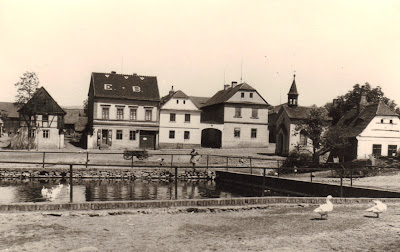

Schichhof Village Square in 1936


Zichov Village Square in 2011

Schichhof Village Square in 1937.

Zichov Village Square in 2011.


Some of the houses were newly renovated, while other buildings showed the traces of time. I sat down in the centre of the village and looked quietly around. Some people were working in their yards, I heard some hammering, probably renovation work. One car came along, stopped near one of the houses, a couple got out. They looked at my with some distrust, not quite knowing what a stranger would do here in this remote place. I got up and walked towards them, putting my most friendly smile on. He did not speak or understand English. I took out my phone and showed him the old photograph of his house, I thought he might like to see it. He looked at it, smiled slightly awkwardly, then went away into the house without further comment. Maybe he thought I want the house back?

I moved on to the next town on my schedule: Bilina / Bilin. The buildings were all still there, slightly modernised, but recognisable.

Bilin, winter 1936.

Bilina, autumn 2011.


It began to get dark, and I drove on, because I wanted to reach the hotel before nightfall. I had booked a room in the nearby town of Teplice, formerly Teplitz, and I found it without any problems. The price per night was very inexpensive: 20 Euro including breakfast. When approaching the hotel, I saw why the price might be a bit lower than usual: right behind began a large industrial complex with two huge chimneys. But now on weekend they were off. The hotel itself is actually quite nice, with a few strange quirks: at the reception during check-in, I had to pay upfront for the night. And I had to book my breakfast in advance, from four choices. Next to the reception sat two young women, chain-smoking. They were still there after I had brought my stuff up into the room and had a one-hour nap - the travelling and the sites today had made me quite tired.

I headed out to find something to eat for dinner. First I drove to another town, Osek / Ossegg, from where I also had a few pictures. But the town was larger than I expected, and in the darkness I was not able to identify anything familiar. There was a kind of restaurant, I peeked through the window, but its neon-lit large room looked empty, there was only the chef and one waiter sitting around bored. An elderly couple walked along, they seemed also to look for a place to eat. They also checked out the place, and I decided that I would go into this restaurant if they would. But also to them this neon-lit room did not appeal to them very much, and they moved on. So I also decided to drive back to Teplice and try there my luck.

Frantisek who also had studied in Teplice, had warned me that some parts of Teplice may not be very safe; and it looked like I was just now driving through one of these parts near the train station. But a few blocks southwest, there was the old town centre, and I parked the car there. Saw a very fancy looking restaurant, and they did have a very good and reasonably priced menu. No goose, but I did order the duck.

Later that evening, I made good use of the free Wifi in the hotel to upload some of the pictures I had taken.


Next day the fog had lifted, and the weather was sunny. After breakfast I went again into the town centre of Teplice to have a look at it in daylight. Then I drove on towards North, up the mountains to the border with Germany. A cold wind was blowing over the lonely hill crest. Strange shops where you could buy wheel caps (who needs to buy wheelcaps in the mountains?). I took a small road through the forest down south and moved again to Osek. Then drove further to Duchcov, Bilina, passing the significant Borek mountain (Borschen), Zichov. Czech drivers seem to know exactly where they want to go, and they want to be there as soon as possible. This is slightly opposite of my approach now, as I am not quite sure where to go, nor am I in a big hurry - so I often turn to the side to let cars pass.

These lonely narrow country roads, of which there are still many, seem to lead directly into the past. I slowly drive along, enjoying the beautiful hilly region of this area.

I am glad that I visited this place. Now I can associate some visuals when there is talk about the "Sudetenland". I may come back again some other time, to explore further, as time was quite limited during this visit.


Here two further links, with very interesting content:

An interview with the two Czech authors Matej Spurny and Ondrej Matejka about their books about the Sudetenland. They are members of the Czech group AntiKomplex.
In Germany there is a research group at the Carl-von-Ossietzki-University Oldenburg which is concerned with research about Bohemistic and Sudetistik.
It is such activities which can bridge divides and can bring people together in mutual understanding.


In Terezin / Theresienstadt

I think that the history and significance of Terezin/Theresienstadt is well known to everybody, so I will not present it here. Since my route up north would pass this place, I decided to include it in my travel plans.

The weather on Saturday was determined by a thick foggy cloud cover, which seemed to make everything grey and depressive. This set the proper frame for a visit of this place of sadness. Coincidentally just 4 weeks ago, I had attended a concert with music of composers who were in Terezin, and on Friday evening, I learned that also cellist Frantisek Brikcius is participating in this project to keep this music alive and make it more known to wider audiences.

Terezin is an 18th century military fortress. I had expected to find fences and barbed wires, but the town is actually open, and people live here. This seemed strange to me, and the whole atmosphere is a bit weird: there are shops and restaurants (advertisement for a pizzeria shows up), but most visitors walk solemnly around. The area is quite large to walk by foot, and I was not able to see every corner of the town. But I visited the central museum, which does provide a very good documentation. There is a room with just the names of all 10,000 children. There are also many exhibits with original documents which described everyday life and procedures.


If I had more time, I would have also have visited the auto museum which is located between the small fortress and the parking lot: they seemed to have a nice selection of classic buses. But I think that somehow such a mundane "attraction" feels misplaced here in Terezin.

After about 1 1/2 hours I drove on, towards my actual destination for today, not very far north from Terezin: the area known formerly as "Sudentenland".

Saturday, November 05, 2011

In Jihlava

When planning what to do during the two days after the EuroPLOT meeting, I immediately considered visiting the town in which Gustav Mahler had spent his youth: Jihlava. I was curious to see the town which has shaped him and to see the same environment that has brought out the creative talent. And so I booked one night in the Gustav Mahler Pension. I also had the choice of staying at the Gustav Mahler Hotel, but I went for the less expensive option. Seems that the good tourism folks there in Jihlava have discovered how to milk the fame of their famous citizen - there is also a Gustav-Mahler-Cafe. Neither of these accommodations has in fact anything to do with the composer - the houses in which he grew up are a few blocks away. The Gustav Mahler House is one of these - he spent there his first 12 years.

After my arrival around 23:00 I went soon to sleep. The Gustav Mahler Pension is in fact quite a nice accommodation: the room is nicely appointed, like a little suite, and the breakfast buffet is very good. 11:00 is checkout time, so I planned to do my walking around the town right after breakfast. Walking through the grey cold autumn morning, the town Jihlava seemed slightly unwelcoming. The sometimes slightly crooked buildings on hilly streets seemed to find their equivalent in Mahler's sometimes slightly crooked harmonies. I could imagine how the small-town mentality felt somewhat limiting.


But then, the exhibition in the Gustav-Mahler-House showed a different aspect: there was a lot of music activity in the town, and also the nature around was inspiring to young Gustav. The exposition in the Mahler house is very interesting: some replicas of equipment that was used in the house when it was his father's liqueur shop. Also there are details about Mahler's bad grades in high school.

I am glad that I got at least a brief impression during this visit from the environment in which Mahler grew up. If I had more time, I would have explored the outside environment, the hills, valleys and forests around Jihlava. But my time schedule was tight - my next stop would be north of Prague. So back in the car, filling it up with petrol, then driving north. Once again driving through the vicinity of Prague, but not touching the center this time. Instead, following just the signs for Teplice and Usti nad Labem.

In Praha / Prague / Prag

The EuroPLOT meeting in Hradec Kralove ended around 15:00 on Friday afternoon. We (Georgi, Margrethe, Nicolai) had our luggage already in the car and left 10 minutes later. The ride was smooth, and we followed the directions to Praha Centrum, which guided us into the entrance from South. Traffic was not too bad, and in less than two hours we were right at the center, west of the Carls Bridge, to drop off Georgi, Margrethe, and Nicolai. I continued to drive on, looking for parking, and found it right near the Rudolfinum. We planned to go out for dinner. But then I got a phone call from Margrethe that their hotel had a problem with the water, and they would transfer to a different one. We agreed to meet on a later date. Meanwhile Georgi checked in fine, and would join us for drinks. However, by the time that Margrethe and Nicolai could make it back to the east end of the Carls Bridge, it was already quite late, and we just went into the very first place that offered something to eat. No point that Georgi would rush over the bridge, as we left shortly after we had the Gulash soup, and then walked to the Rudolfinum where the concert started at 19:30. I would have joined them, but I did instead meet with cellist Francisek Brikcius who studied one year in Leeds and knew people there. He gave me a detailed tour through the old town of Prague, and we had a nice chat about music, politics, Leeds, etc. I took
some pictures of the nightly city, which was naturally very impressive in all its architectural glory.


Then it was time for me to continue, and I drove on towards south on the Motorway, listening to the music on the CD which Frantisek gave me. Shortly before 23:00 I arrived at the Gustav Mahler Pension in Jihlava.

EuroPLOT Meeting

The EuroPLOT project is about "persuasive learning objects and technologies" (PLOTs), which are to be developed and to be tested in four case studies. The team (6 institutions from 4 European countries) meet every 6 months face-to-face, in addition to several online meetings. This was the third meeting, after one year into the project. Since Janet's retirement earlier this year, I have been asked to lead this project further.

It is indeed a very interesting project, linking several of my interests in teaching and learning technologies, and the partners are highly qualified and specialists in their respective fields. The user case studies range from academic university courses, language learning, industrial learning, to heritage and tourism. At this meeting, one of the goals was to link these user studies tighter to the persuasive design elements, as envisioned in the original project plan. I believe that this was achieved in the past two days. We also got the opportunity to use the two software tools GloMaker and PLOTLearner in the latest versions. Nicolai chose me as a subject to test the German language case, using the Tiger database of German newspaper articles. I am ashamed to admit that I failed the tests miserably! It appears that my knowledge of the German language is only very rudimentary. So it is very good that we now have this new tool, with which I can brush up and improve my command of the German language!

The meeting was very well organised by Jarka from U.Hradec Kralove, and we had good opportunities to sample the delicious Czech cuisine and a couple of Pilsener Urquells.

After the meeting I will stay in the Czech Republic until Sunday, to do some travel in Czechia.


Georgi had a hotel reservation in Prague, and so did Nicolai and Margarethe. So I decided to take them into the (small) rental car into the city, before I would head off to my other destinations.

Thursday, November 03, 2011

Travel to the EuroPLOT Meeting, Hradec Kralove

After the farewell dinner with our friends from India, I went back home for the weekly evening online chat session with my student group in California. However, in the UK the time has changed from daylight savings time to regular time, whereas it has not yet changed in the US... so when I went online, only a few students were there, as they had been already waiting for one hour... why can the daylight savings time not be changed simultaneously in all countries of this planet?

Then, after midnight, I began packing my stuff for the travel next day, and I was done with everything at 3am.

Wednesday morning was cold, grey, foggy in Leeds. Driving to the airport, then a bit of sun came out. Leeds-Bradford airport was very empty, I got immediately to the check-in counter. Later I meet Georgi from LeedsMet who is also travelling to this meeting: the bi-annual face-to-face meeting of the project EuroPLOT, in Hradec Kralove, Czech Republic. Departure was on time, and arrival in Prague was 20 minutes ahead of schedule. There was a thick grey cloud cover, no sun came through.

I got a white Fiat Panda. Nice car, but the 1.2i engine seems quite weak.
Instead of driving around Prague on the south side, Georgi and I decide that it might be nice to drive straight through Prague towards the East. And yes, we had a glimpse at the illuminated Hradschin, after crossing the river Vltava (Moldau) near the Karls Bridge, as the evening darkness set in. Around 19:00 arrival in Hradec Kralove.

Nice meal for dinner: Altboehmische Kartoffelsuppe, Lendenschnitte mit Boehmischen Knoedeln. And Pilsener Urquell.

At the after-meal walk, I see the participants from Krems: Peter and Erich, who just arrived. And then we meet Nicolai, Margarethe, Helle, and Tom. A few of us decide to go out for another pint, and we end up in the Na Hrade restaurant. When we enter, a very familiar smell hits us which I had not smelled for quite a while: cigarette smoke. It is apparently (still) legal to smoke in bars and restaurants, and this smell is somewhat reminiscent of past times. The bar itself with its interior decoration at the wall appears also to be so nostalgically out of the past.

And now the mind moves to the EuroPLOT meeting which will take place on Thursday and Friday.

Visit of our Friends from India (Gujarat) in Leeds

I have been to India twice: in November 2008 and in January 2011. With members of the organisation "The Rivers Movement", directed by Brian Lewis, we had traveled to Gujarat and visited there the Sardar Patel University and other educational institutions, and we had made many friends there. Now the plan was to bring to the UK four of these friends, to facilitate a mutual cultural exchange.

Our four friends who would visit us were: Asha Makhecha, lecturer at Sardar Patel University in Management and Business, Surendra Gohil, lecturer at Sardar Patel University in IT Education, Juhika Bhanjdeo, artist, and Chhaya Uphadya, teacher and educator. A program for their visit was worked out by the local team here in Yorkshire (Gina Hawkins, Deborah Bullivant, Brian Lewis), taking care of the various interests of our visitors, and thanks to donations and fund raising we were able to collect funding for the flights and accommodation. In August 2011, our four friends from India applied for their travel visas. But then in September, we got the news that despite four identical visa submissions, only Asha had gotten her visa. So suddenly, instead of four visitors, we would only have one coming to the UK. The program was changed, and we booked the flight for Asha. In the meantime, the visa applications were submitted again, with additional documentation and with letters from the sponsoring organisations in the UK. And indeed, one week before the planned travel date, the other three (Chhaya, Juhika, and Surendra) also got the notification that they would get the visa. Fortunately the ticket prices at Emirates Airways had not gone up too far, and we could buy the three remaining tickets. However, a few days before the flight departure, they still had not received their passports with the visas in them... and we all got worried. Juhika finally had to fly to Mumbai to the consulate to pick them up herself, and the group only held the passports in their hands just six hours before their departure from Ahmadabad!

They arrived on Thursday, 20.October, and Gina, Deborah and Brian took good care of them, organising events and meetings. The following Sunday I joined the group, and we had a memorable train ride on the Middleton Railway in Leeds and a visit to the Saltaire Museum. Then last Wednesday, they visited LeedsMet, and on Friday there was the "Pockets exhibition" in Castleford, with Juhika's and others' art works.

Then Tuesday evening was their last day in Yorkshire, and we met for dinner at Barnsley Northern College. Next day they would travel to London to spend the remaining days of their stay.

It has been great to see them again during her stay here in Yorkshire, and I am very privileged to know them and count them among my friends.

Thursday, October 27, 2011

Interview with TrendPOV


A few weeks ago I received an email from Dr. Amy Vanderbilt with an invitation to appear on the TrendPOV show and chat about Augmented Reality (AR). At that time I was not familiar with TrendPOV, and I learned that this is a one hour web streaming show about certain topics for businesses.

This sounded quite interesting, and so I agreed to participate in this. I prepared a CV and sent my picture. Then I decided that it would be good to update my website. Unfortunately, weeks passed by, and I still had not found the time to prepare a new version of my web presence. So on this Monday I finally began to set up a new Google Site for a new portal to my site(s). Not much time to put any content in, so I placed a link to my site at LeedsMet which contains the most relevant Augmented Reality work.

Then I prepared for the recording of the show, which would take place today, Wednesday, 26.October. I had taken the day off because of our friends from India were here on a visit, and I joined them for a few activities during the day. But then in the evening I went back to my office at LeedsMet and set up everything for the Skype session. I was supposed to call in at 6:50pm. There was still some time, so I some other work. Suddenly I noticed that the EDUROAM WIFI started to fail around 5:50pm. The signal dropped from 5 to 1 - what was going on? It looked as if an access point was powering down... So I tried to use another laptop computer which did have the credentials for the wired Ethernet. A pity, because this meant that I would not be able to use the built-in camera of the first laptop computer. When trying to setup the second laptop computer, I was not able to get the internet going. WIFI was out, and the Ethernet connection kept giving problems regarding the proxi server. I am sure that the credentials were correct - that all had worked fine a few months ago. But now it did not... and so I had to resort to the third option: using the office PC with its two monitors. I rarely use that PC, since most of my work is on the laptop(s). But at least there I got a reasonable internet connection. So the picture here with the four monitors does really not reflect technical sophistication, but actually shows the sad state of an emergency solution.


Then another problem: how to affix the camera on top of the monitor, so that I could look right into it and see the screen at the same time? This webcam did not have a suitable base, so I had to stick it with tape onto the top of the screen. It worked ok then, and I was ready for the show to begin.

I dialed in at 6:50pm. Had a video chat with Dr.Amy first. She was very enthusiastic about the Augmented Reality concepts and was really looking forward to this show. Then the show began. On the skype monitor I only saw a logo, but I heard the show then live, the music, and then Dr.Amy speaking. And then we talked about Augmented Reality for a whole hour. I gave my opinion and assessment about the AR technology. Unfortunately I got carried away and forgot to put a plug for the ongoing ISMAR conference in Basel, something that I actually had wanted to do. And when I talked about the LeedsMet project "Our City, Our Music", I forgot to mention the main proponents Ben Dalton and Megan Smith. But otherwise I think I got everything across.

It was a fun experience!

--- Update 3.November 2011: the video is now live online, see here on the TrendPOV site.

At one point during the recording a slight technical problem happened: in my LeedsMet office, the lights are dimming off, once they do not sense any motion in the room for a certain while. And since I did not move that much while speaking into the camera, the sensing switch-off kicked in a few minutes before the first commercial break, and then the lights dimmed away, and it got quite dark. Fortunately I did have another non-dimming lamp on, which kept my face illuminated, and so I just kept talking as if nothing had happened. Then during the next break I did bring the lights back by getting up, and from then on they stayed on fine until the end.