Thursday, January 13, 2011

A lifelong dream came true: driving an Auto-Riskshah - and I mean "driving", not being driven


Before we went to India, I had toyed with the idea of renting a car in India for a few days and to travel around a bit, independently, just following the road signs, stopping wherever I felt. From my first visit here I knew about the road rules, or more correctly, about the absence of those, so I felt I could do this without a lethal accident. But when searching on the internet for opportunities to rent, I noticed that this would only be possible in Ahmadabad, about 2 hours away from where we are. So I almost gave up that idea. Jokingly I told Brian that I might rent a rikshah instead, just to drive around a bit in Vallabh Vidyanagar. And yesterday, Dr Jadeja told me that it would be possible to rent a rikshah - with an accompanying driver. Great! So on Thursday morning at 9:30 I went to the HM Patel institute where the driver Harish with his rikshah was already waiting. First I got a brief instruction: there are three gears, to he shifted with the left handle. The "neutral" is between gear 1 and 2. The clutch is operated with a lever at the left handle. The right handle turns the throttle. There seems to be no idle, the throttle has to be operated always, during starting, and during idling when standing, otherwise the engine dies. The brake is operated by the right foot. The horn (very important) is operated with a button by the right hand, which then has to be removed briefly from the throttle handle (or you need to have a large hand). The blinker is a switch near the left handle, but no finger can reach it while the hands are on the handle, so one has to remove the left hand from the gear switcher. Very un-ergonomic design, that 1950s Pioggo from Italy. But as we slowly do a test ride around the block, I get the hang of it. Brian sits in the back and enjoys the ride. The test ride immediately develops into the real ride, and we drive out of Vallabh Vidyanagar towards west, on the road to the temple town Vardtal. Traffic is light. The speed indicator is not working, but I have my GPS: it shows almost 40 km/h. The driver keeps telling me "slo, slo"... While driving this rikshah I can now appreciate the difficulty in multitasking which these drivers have to do: in addition to the actual driving task, meaning operating the non-ergonomic machine, one also has to pay attention to the traffic situation, watch vehicles in the back, front, and sides, swirve around potholes and avoid speed bumps, overtake pedestrians, cows, dogs, camels, and tractors, be overtaken by basically everybody else, and avoid any kind of collission with anyone. This is quite a number of tasks, and I hardly manage. Especially because the side mirrors are not well adjusted - I have to move my head very far out of the way to see anything, and they I miss what is ahead of me. So I simply rely on other vehicles sounding their horns, and I also use every opportunity to beep the horn, to warn everybody that I am approaching. The turn signal indicators are of no use, because our accompanying driver has wisely switched on the alarm blinker, indicating that an "incompetent driver" is now operating his machine.

On the way we pass the village "Jobanpura", and I decide to stop and have a brief look.

We go on towards Vadtal, and that town always has a special flair to it, with its temple in the center, its gates, the buzzing crowd around the stalls. I take a few pictures, then we return. We stop at the guest house to pick up Gina and Deborah, to give them a lift as they have to go to their next appointment at a local school. So I am now officially acting as a rikshah chauffeur. But their destination is too far away for me, the two hours rental are soon over. So we drop them at a busy intersection where they take another auto rikshah. A few minutes later they overtake me laughing.

A brief stop at a bank for exchanging some money, then we are driving back to the HM Patel institute.

That was fun!

Wednesday, January 12, 2011

Fifth Day in India

We get up around 5:30 am. For the first time on this trip I find a good use of the Immodium tablets that I had taken with me. Maybe one of the 10 chillies which I ate yesterday was not so good...


We drive to a temple in the hills to watch the sunrise above the Narmada river. Then we continue to a waterfall which is called something like "Dshermanie". I keep hearing "Germany" when our Gujarati friends talak about it in their native language. The dusty dirt road goes in winding curves up into the 7-ridges mountains. When we reach the destination, we visit a tribal family who lives in a wood hut with her children. We brought some sweets with us and hand them out to the children. Walk along the water to the waterfall, crossing the stream a couple of times on rows of stones in the water. A little girl offers Gina a kindly helping hand while walking across the river.

We drive back towards Vallabh Vidyanagar, because Falguni has to be at the institute before 1 pm.

In the afternoon we have a rest, and in the evening, Surendra and Jinny visit us at the guest house, and we drive with an auto-rikshah to the North-East exhibition.

For the upcoming kite festival Brian and I decide to by kites. We go for the largest ones in the store, because they are the easiest to fly. Also bought some strong string which is fortified with a golden glass powder. We have been told that during the kite festival one of the goals is to bring down the kites of others - by trying to cut their wires with your own wire. Supposedly there are every year during the kite festival stories in the newspaper about people fallong down from balconies, or heads of careless motorcyclists being cut off with those wires...

Tuesday, January 11, 2011

Fourth Day in India

Breakfast at 7 am. Then at 8am, Gina and I are being picked up by Piyus Joshi and Falguni in a rented taxi, to be driven to the Narmada Dam. First we head north, to pick up the engineer Pandya who works at the power station of the dam, and with him we will get access to the inside of the station. The whole ride takes several hours, driving partly on the expressway towards south, then leaving it and driving on smaller roads which lead through bustling little towns.


We stop at the heritage site Dabhoi, where we can see two ancient gates with rich ornaments.

Lunch at a rest stop. Delicious fried chillies - I cannot stop eating them!

We arrive at the flat where Pandya lives - that is where we will spend the night. We are not allowed to take many things into the power station, especially cameras are forbidden. I take mine in the pocket, since it is so small. Several control posts control access to the dam area. The vehicle is searched with mirrors, we all have to get out and go through a metal detector. When I go through, it gives an alarm. I begin emptying my pockets, first the paper-based notebook which I always carry with me, then the pen, then the roll of emergency toilet paper which may come handy, and then the guard is already satistfied, and I can go through.


A tunnel leads into the rock downwards. Inside is a huge hall, where 6 generators can create a total power of 1.2 GWatt. They are off now, are only to be switched on when demand raises. The dam's main purpose is not creating power but providing irrigation.

Afterwards we drive back to the engineer's flat, pick up our staff, and drive to a sustainable farm where a family provides for all their needs on their land. They do not use pestizides, have a very economic use of water, and have something very interesting: solar cookers from the German company of Wolfgang Scheffler. A parabol dish similar to a large satellite antenna directs the sunlight onto a single spot where a pot stands - and this pot would be heated by the sun rays. A spring-powered mechanism moves the "antenna" so that the pot is always in the hot spot (focal point) of the mirrors.

Furthermore, the family manufactures soap and healing powders for various illnesses. Everything is made so that it uses the least possible amount of energy and resources.

I discuss with one of the sons the implications of our modern technology. While he advocates a life back to the origins and suggested to limit human curiousity and the quest for "progress" as it has brought much bad consequences (atomic bomb, climate change, destruction of nature and natural resources), I advocated a quest for progress to overcome these difficulties. I would not want to live in a society that is completely without growth, and I would not be satisfied with the simple life alone. Human quest for knowledge has not yet produced a knowledge of everything, as every answer to any question raises new questions. And we need to follow those questions and try to answer them. This is only possible by using significantly more than just the standard resources which a tribal community would consume. But of course we need to watch that everyone gets his/her fair share in the use of these resources, and that they are not exploited too much and destroyed by over-utilisation.

We head back in darkness to Pandya's flat where we go to sleep around 10pm. Will have to get up very early in the morning.

Monday, January 10, 2011

Third Day in India

On Monday morning I again woke up around 5am, but I did not feel tired. I used the time to try the USB stick again, and it worked great! I uploaded all pictures I has so far onto Flickr, and responded to emails.

This day would be devoted to music. We wanted to show to the same class as yesterday the music which I had written for the Rivers Movement: "The River Aire", after a poem by David Wilders. The students should then try to find words which were embedded in the music. This was a very interesting experiment, especially becaise these were Indian children, and the music had been written in a Western classical style. The schedule for the day changed a few times, but it was finally set that this lecture/performance would be given from 14:00 - 15:00. In the meantime I prepared a video of this music, with the corresponding words from David's poem shown synchronous to the music.

The internet worked fine, no need to exchange the USB 3G stick.

The lecture in the afternoon at 14:00 started with me switching on my laptop computer, connecting the audio to the speakers, and then playing the wav file with the recording of "The River Aire". 95 Indian English teacher students are the very first people on this planet who hear this music being played. They are being told to write down words and impressions of this music. After 10 minutes it is finished, and they "report" threir impressions. it is amazing how well they were able to capture the spirit of this, not having seen the original poem by David wilders on which this music is based. They mention words like "storm", "calm", "serene", "raging", "animals and plants" (how did they get this one? pretty good!). This shows that music is a cross-cultural language, even if it has some local "dialects". Later we listen to a recording of Indian music about rivers, played with flute and sitar. and yes, you can hear the river there as well, with its waves and flow.

The video of the music is here:

It is to note that this is still an incomplete draft - when I am back from this travel I will add the missing 11 words, and I will revise the instrumentation and composition to make it more consistent.

At 15:00 Surendra and Falguni take Gina, Deborah and me to a tribal village school outside of the town, which is away a 45 minute drive. We see children in their classes, and Gina and Deboray talk with their teachers. I document with camera and video the activities. When the classes end at 17:00, all the children walk out and wave to us. Then we take a walk around the willage. Small mud houses, surrounded by farmland. Women carrying fire wood on their heads, men plastering house walls, and everybody smiles friendly when we walk by. It appears that everybody wants that we take pictures of them - so we do. And it appears that the polite thing to do is then to show them their picture on the camera screen. Thank goodness for digital technology!


Already during my last visit to India two years ago I was wondering why almost everybody there was so keen to have their pictures taken. I came up with a theory: when a picture of them is taken, their image goes onto a journey. They themselves may not have the opportunity to see the rest of the world in the near foreseeable future, but their picture will. Their own eyes will not see the world, but the world will see them on their image - so in a way they do travel and get connected to the rest of humanity, to whoever sees their image. So I keep taking pictures of them, to fulfil their dream of being seen by the world (or whoever has a look at the pictures).

In the evening when we return to the HM Patel Institute, there is a group of young students from Surat, supervised by Ashok. They are also very keen to have their pictures taken.

Sunday, January 09, 2011

How I got interviewed by the police

On Sunday afternoon I walk alone along the main street in Vallabh Vidyanagar, on the way to the DBS supermarket. Very busy, very dusty. Everyone is staring at me, and I attract significant attention. Not sure if it is just the fact that I am the only Westerner in the whole town who is walking here, or if it is my GPS unit that I am wearing around my neck, or the fact that I take pictures of almost everything I see: cows, buildings, just the road...

And walk by a group of three policemen who are sitting on chairs, chatting with each other. Maybe I looked somehow suspicious to them; after I am already away about 10 meters, one of them shouts after me "Hey, come here". I think I better follow. With a big smile I turn around and walk slowly towards them. One gets up and points me to sit down on the chair. I do this. "Where are you going?" I say that I am going to the supermarket. "What do you have in the bag?" Cake from the bakery around the corner. "Where are you from?" Not sure what to answer, but I say "Germany". At least they cannot release any anti-colonialistic resentments then - the relation to the former colonial power here in India has still a slight tension. They all smile while they ask me these questions, so this questioning feels kind of weird: maybe this is not an official inquiry, but just a chat... ? There is actually a meeting of police here in the town, for a kind of drive around various towns, as I have seen the signs "Vallabh Vidyanagar welcomes police from..." and then a couple of towns listed. So we talk about that. Then I say that I have to go now before the supermarket closes. A friendly good-buy, and I walk off.

On the way back I stay on the other side of the road, just in case.

In the evening we have a tea with the cake which I bought, and we have a laugh while I tell the story to our group.

Second Day in India

I slept very well, but for some reason already woke up at 5am. This was quite strange, as I had expected to sleep longer than that, because the time zone difference in India put us there 5 1/2 hours ahead of UK time, which means that 5am is 11:30pm UK time. All those sleepless nights in the past days must have reset my inner clock to a wrong time...


It was very surprising to us that the uni staff was working on a Saturday, and that students were actually attending lectures. But even more surprising was that the same thing happened on Sunday: a full day of lectures was scheduled, and we were given a two hour slot to give presentations. The students are future English teachers. Brian introduced them to the Rivers Movement, Gina talked about her work at Barnsley College, and Deborah about her work in the education sector in Rotherham. My presentation was about teaching with technology: I talked about SCORM and learning objects, showed what you can do with CourseLab, and pointed out how this could be used in the educational context with very little resources.

The USB 3G stick was not functioning well, I had hardly been able to get to any website. So Sunil decided we should go back to the store on Monday and cancel this 3G plan.

I used some free time in the afternoon to do some shopping of water, cake, and some cleaning utensils for the bathroom.

Saturday, January 08, 2011

First Day in India

After another night with only a few minutes of sleep we had arrived in Ahmadabad around 3:00 am. In the baggage claim we were for a long time looking for our luggage, and we were afraid it might have gone lost in Dubai. But after a while everybody of us had their luggage, and so we headed through the customs control. The flight attendants of our flight to Ahmadabad had not given any of the passengers an immigration form, so there was a rush to get these forms. Quite a chaotic queue formed at the immigration desk, with people getting to the front to bring back these forms to the waiting passengers. In principle the queue was supposed to be meandering in an S shape, separated by barries. But some people decided to shortcut the queue by going straight instead of following the S-shape, by removing the barriers. Some heated "discussions" started then... We finally made it through the immigration, and then went outside, where our driver greeted us. It was 4:30am.


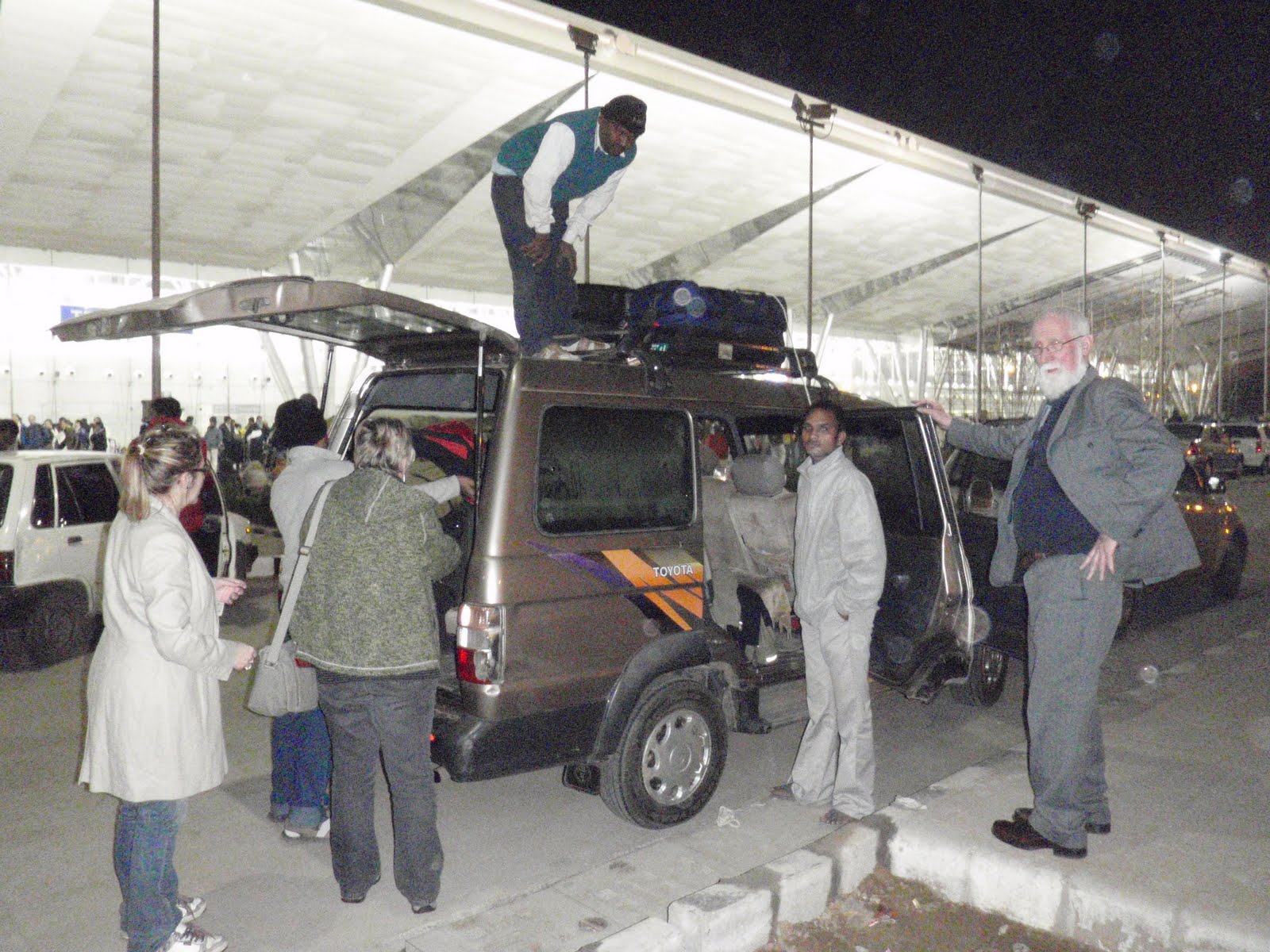
A crew of 3 people had come to pick us up. They had been here since 1:30 am, due to a misunderstanding of the time communication. When loading the luggage into that Toyota van, it became apparent that there would not be enough space for the four of us to squeeze onto that one backbench - so someone would have to go into the luggage compartment. Gina and Deborah volunteered because they were smaller than Brian and myself. So our three drivers rearranged the luggage and put some onto the roof, where it was affixed with a very thin looking piece of string... it was not really our intention to treat the ladies that way, but that is how it turned out to be: their luggage on the roof, and they into the trunk. The car had seatbelts in the rear seat, but when I tried to put it on, there was only one half of the seatbelt - the parts where to stick it in could not be found anywhere. Fortunately everything went well, and almost two hours later we arrived safely at the university guesthouse in Vallabh Vidyanagar. During the ride Brian and myself noted that the road near the airport had been improved significantly - much fewer potholes. We drove around Ahmadabad on a kind of ring road where the early morning traffic began. The temperature was relatively fresh, and we saw many people outside with scarfs around their face. In combination of those scarfs with some automated guns which a few of the guards at the toll stations were wearing, it looked as if that toll booth had been hijacked by a local warlord... in many places a few people stood together in a group around a small fire, to warm themselves.

After arriving at the guest house we moved into our rooms and had a few hours of rest before we headed at noon to the university to meet our hosts Sunil Shah, Dr Jadeja, and Surendra. We received a heartfelt welcome. Turns out that my Twittering (tweeting?) and facebooking had kept everybody here well aware of our travel obstacles, and they had felt very well informed and up to date. Sunil as the ICT expert suggested to me that I should get a Tata Docomo 3G USB stick for a fast mobile internet connection, and so we headed off on his motorcycle. I felt a bit unsafe, but Sunil was driving very cautiously through the Indian road traffic with its 3-wheel motor rikschahs, motorcycles, cars, tractors, pedestrians, cows, and the occasional camel. The question of wearing a helmet never came up... what is a helmet anyway?

Got my USB stick, drove back to the university, but it did not work... some driver problem. Must be because I had other Huawei drivers installed from another earlier device... and the software did not appear to handle this case very gratiously. So we went back again to the Docomo store to get some help. However, the IT guys there were not very well versed in computer installation questions and just were able to offer some generic help. What I needed was an explicit Huawei driver which I could install separately. After a few hours tinkering with the registry and reinstalling the device several times I finally got it to work- and the afternoon was over.

Back at our guesthouse the electicity went off for 1/2 hour, leaving us in complete darkness, except for the bluish glow of my laptop display running on batteries. But a few minutes later the house attendant came with a candle for everyone.

Kiran, Falguni and Mitali who had visited us in Yorkshire in summer 2009 came to the guest house to welcome us, Then we headed to the restaurant "Colour Flavours" where we were treated to an excellent meal by Falguni. As usual, I had something sizzling - I like it when the food makes a noise.


On the way there were many stalls on the road selling kites. Dr Jadeja explained that this is for the upcoming kite festival, and Sunil invited us to experience that festival in his home on Friday.

Back in the guest house I tried the internet stick, but the performance was very spotty. Often no web site could be reached. Only a few times I was able to see my emails, reply, and send out a tweet.

Friday, January 07, 2011

A Day in Dubai

We have been told to go to the Transfer Desk after our arrival at Dubai Airport. The queues there are not very long, but are moving very slowly. When it is finally our turn, we are told to go to another desk in the arrivals hall, to the "SPTC" desk (or something like that). In any case there is no desk with that label, so we just go to the customer service desk. Turns out to be the right one. After some waiting in another queue we receive a voucher for a hotel and a one-day visa for visiting Dubai.

Our luggage stays checked-in. Fortunately I had taken in my carry-on a set of stuff so I could survive for 2 days without the suitcase. Waiting outside for the hotel shuttle. A blue-sky morning, with mild air. Reminds me somehow of Southern California. The Shuttle drives to the "Majestic Tower Hotel". This is not THE tower in Dubai, but is located towards West of the city centre. Very classy hotel, 24 stories high, with all amenities. We freshen up in the rooms and then have some breakfast at the buffet. There is a pool on the terrace. And free Wifi! So I can upload my first tweets from the travel.


We take a taxi to the Burj Khalifa, which is the name of THE tower, currently at 828 the tallest building in the world. It is within a kind of park, with an artificial lake in the centre a large in-door shopping mall to the right (they have there a California Pizza Kitchen and a Nordsee restaurant - very international) and another indoor mall with Arabic crafts to the left. Very generous space design, but quite empty and devoid of people. Brian's comment: "this is how I imagine hell". But I like it - it really reminds me of the outrageousness off Southern California, with the everything-is-possible attitude. This space is built for the future, eventually there will be tourists here. Yes, it is a bit commercial with its Gucci and high-class luxury mall shops, but I find it is also forward-looking optimistic. In any case, I like high buildings, and currently it does not get higher than this! Of course I take the opportunity to go up to the tower - the elevator moves at up to 10 m/s. It ends at the 124th floor - there are still about 38 more floors on top of that - a total of 162 floors! This building is just incredible. Most offices and flats are empty - like the Empire State Building during its first decades. This tower is ahead of its time, but I think that it will see a great future.

Since we would stay not even one full day in Dubai, we had not exchanged any money. In the stores foreign money is accepted - but only US$ and Euro. The UK pound is not accepted... this became a problem when I became thirsty and wanted to buy one of these sparkling lemon drinks. But the lady who made the drinks said - "ok, I can give you that for free". Now that was very nice! I found a grocery store in that Arabic mall where I could buy with my credit card a few bottles of sparkling water and freshly-pressed grapefruit juice.

At around 1pm we decided to go back to the hotel and use the rest of the time to get some sleep. It was a pity to waste that beautiful warm sunshine, but we really were quite tired and needed some rest, especially with another long awake-night ahead. I fell asleep like a stone and slept for 4 hours. We then met for a drink in the hotel bar, then had dinner in the restaurant. Excellent food, again a buffet. At 21:00 pm our shuttle left and brought us back to the airport. We went straight to the gate, since we already had the boarding passes. Since this was a rebooking, we did unfortunately not have window seats... so again no GPS flight tracking. We tried to sleep, but the flight was just too short (2 1/2 hours) to squeeze more than a brief nap in between take-off, food, and landing. At 3:00 am we landed in Ahmadabad.

Travel to India

Over the Christmas holiday I was quite busy with a variety of things: preparing for the travel to India, fixing loose ends on a variety of work-related things, for example marking students' work, setting up a website for an unrelated project, and working on two music projects. For the "Rivers Movement" I had taken on the challenge to put into music a poem by David Wilders which he had created for this project: "The River Aire - From Source to Castleford". In October he presented this during the workshop series in Castleford, and I had begun to translate this into music. But I had not gotten much beyond the Malham Cove... Now for our travel to India I wanted to complete this, to "perform" it at some events there. But time was running out... I had to complete all the work for the university during the two days 4. and 5. January when I was at work. and could devote no time during the day to the composition. Only in the evenings I could do some, and it progressed very slowly. So I decided to shorten the poem and at least create a music which is in itself complete, with a proper ending rather than the fragment I had before. This was finished at 23:00 on 5.January, the night before the travel. Finally I could then start packing. That was done at 2:00am. Then some final work on that web page for the "Connecting Enterprising Women" organisation - completed at 4:00am. Time for some sleep. Getting up at 6:30, leaving for Leeds train station at 8:00. The Leeds Tourist Office there is closed until 9:00; I had hoped to get some presents for our friends in India, but now I have to wait until the store opens. I find a few things there and stuff them into my suitcase.

The train leaves on time at 9:25. Brian already has been waiting at the platform. I still have to complete two reviews for a conference and one for a journal... I take my laptop out and work on these during the ride to Manchester Airport.

As we enter the check-in hall in Terminal 1 around 11:00, there is a huge line: it is the one for the check-in to Emirates Airways. An Emirates employe distributes a paper, in which the latest problem is explained. Just like when the volcano had erupted... The paper states that the outbound flight to Dubai is delayed by 5 hours. We go to the baggage drop queue which is much shorter than the general check-in queue. But it moves very slowly, about 10 me per hour as I am going to find out. At around 12:30 we finally are at the counter. Since we have a connecting flight from Dubai which we will miss, we have to be rebooked. Not many flights to Ahmadabad, either the same day at 23:05, or next night at 4:25. We are now all being re-booked on the 23:05 flight, and Emirates will provide a hotel accommodation where we can rest during the day. Which means we will now arrive a day later in Ahmadabad, but we will have an opportunity to see Dubai.


One problem comes up when my suitcase is checked-in: 34 kg is definitely over the limit - Emirates has a 30kg limit, which is already quite generous. So I unpack some of the book presents and put them into Brian's light luggage - problem sorted.

We have a lunch at the "Giraffe" at MAN, and I complete the paper reviews. Then I finish some last updates of the CEW website, then I am finally done with all the loose ends. In the meantime I kept the world updated of our status through Twitter and Facebook. Which turned out to be very useful because our friends in India then already knew about our delay, before we gave them a phone call to alert them about our delay.

The flight took off at 19:45. I had never flown in the Airbus A-380 before. Feels very smooth and quiet. Nice are the outside-view cameras. Despite sitting at a window seat, I cannot get a GPS reception. Maybe the window opening is too small, maybe the class is covered with a shield. Maybe the wall insulation is just too thick - I cannot place the GPS receiver close enough to the window. So no flight tracking this time. I watch the movie "The Social Network", then doze a bit. We arrive in the early morning in Dubai, after a second night with very little sleep for me.

Wednesday, January 05, 2011

Preparations for Travel

For quite a while our "The Rivers Movement" project group had planned to go for a second time to India. After our first visit in November 2008 our friends from India had visited us here in Yorkshire in June 2009, and we had planned to return the visit. The "Rivers Movement" project's goal is to create awareness of climate change by means of art and writing. I had joined this group in 2008 based on my interest in geo-centric interfaces, and I contributed to it by doing some of the photography and documentation. Originally the second visit had been planned for November 2009, but then got postponed due to a variety of schedule conflicts. Finally the travel had been booked for April 2010, but then came the volcano - and air travel was at a halt. We had to cancel the travel that time, which was quite a disappointment to everyone. Finally travel was arranged again for the 6.January 2011.

For travelling to India a visa is required, for which the passport needs to be sent to one of the consulates in the UK. I needed my passport for other travel and could only send it at the end of November. The official processing time for it was given as 10 working days, so time should be sufficient. But it was cutting it a bit close. The online application process just had gone through a change, and a new "system" was implemented. The visa application form now includes questions about the applicant's religion and about the military service. At one point I realised I had made a small typo in one of the phone numbers to enter - but there was no provision of going back and changing, once the form had been submitted - had to start filling in another form from scratch. The new online application process seemed to be a bit convoluted, somewhat counterintuitive and with very few explanations, but after about two hours everything was done. The first major problem came a few days later when our team leader, Brian Lewis, had indicated in his form that he is a free-lance writer. He received a phone call that this would be in violation of a "tourist visa". He quickly had to send a fax, stating that he is in fact retired. This was to be done the same day, as he had done his application through an off-line process, which still used "the old forms", and these would expire the same day. Another problem was uncovered by our co-traveller Gina Hawkins, who received a phone call that her photos were not right - they needed to be at least 2" by 2" (5cm x 5 cm) large. This exceeds standard passport picture size, so she had to get quickly larger pictures. I became a bit worried, because I just had sent two standard passport pictures, so I tried to inquire online about the status about a week after I had sent the application. The status inquiry was negative - my passport had not been in the system. This was just after the December-freeze had befallen Britain, with delays in the postal delivery. So I send an email to the online inquiry, with my data. Simply the online reference numbers did not help, only after I had also sent the postal tracking number, it was confirmed that my application had been received. No comment about the photos, so I thought everything is fine. After the christmas holidays I became a bit worried, as I still had not received my visa after more than 3 weeks. and I realised that I had forgotten about those bank holidays which brought all economic life in Britain to a standstill. On 30 December, Deborah Bullivant, our other co-traveller, sent us an email that she had just received a postal mail from the consulate, rejecting her application - because of wrong passport size. She had to travel to Birmingham and hand in her application in person, this time with the right pictures. I got really worried now - had gotten a SMS that there is a courier mail from the consulate. This would probably also contain my visa rejection, and I already prepared for a trip to Birmingham myself. Luckily the post was actually my passport, with the visa in it.

On 4.January Deborah picked up her visa in Birmingham, and now everything was ready for the travel.