Sunday, November 12, 2006

An Afternoon in York

During the Leeds Met Staff development festival this September, one of the "fringe activities" had been a tour through York. Many people had signed up, and not everyone could participate. So in order to accommodate those who could not take part in that tour, Deb Chapman repeated this tour on Sunday, 12.November 2006.

It was quite cold and chilly, as we walked through the town to various historic places. We saw several Roman sacrophagi and went on a segment of the wall around the town. Deb told about a few ghost stories for which York is so well known.

During the walk around the town on the wall.

Evening in York.

Friday, November 10, 2006

Annual EPSRC Conference, London

On 2. November 2006, the Annual EPSRC conference took place in London, in the British Library. EPSRC is one of the main agencies in the UK for funding engineering research.

Originally I wanted to travel the evening before, to spend a night in London. But I had lots of things to do here in Leeds, so I could not afford this. Instead, I got up early, drove to Leeds train station, and took a morning train to London. The ride takes 2h 10 minutes, from Leeds to Londong Kings Cross. I was quite tired, so I slept most of the time.

Early morning at Leeds Train Station.

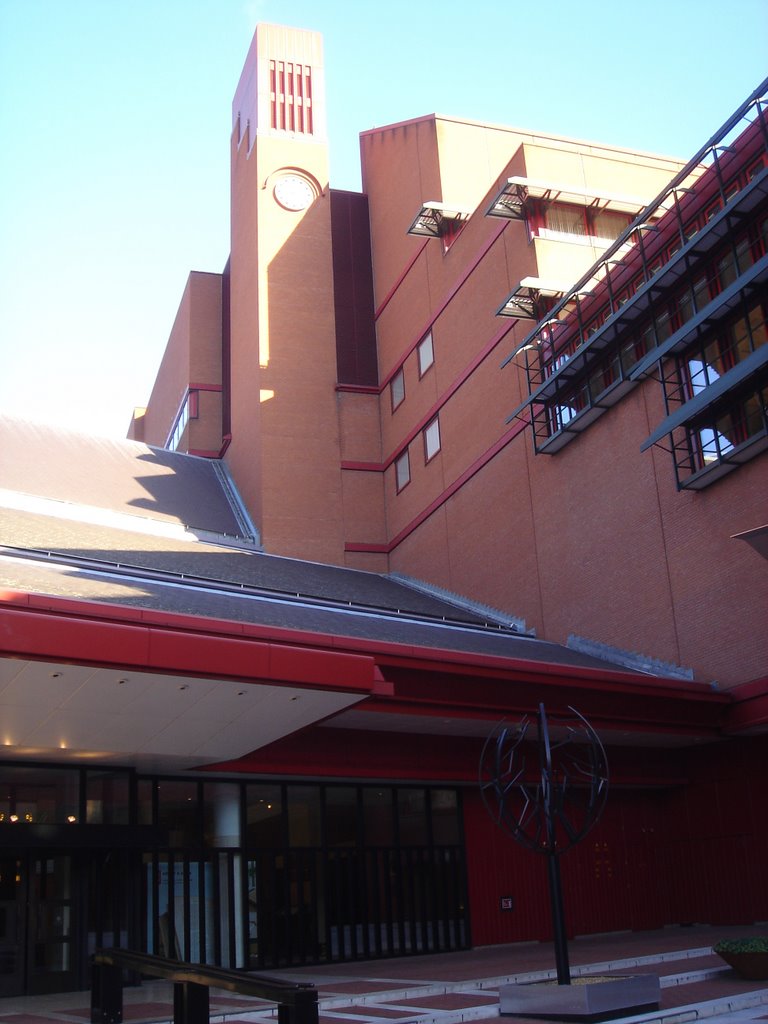
The conference venue was the British Library, just a few steps from the train station Kings Cross.

This one-day conference served two purposes:
  • for the senior management of EPSRC to give an overview on the future funding strategy
  • f or the participants to network for possible collaboration opportunities.

The first presentation was given by Professor Dame Julia Higgins, chairman (chairwoman?) of EPSRC since 2003 (vacating the post in 2007). She pointed out the results of an earlier consultation process, which identified the following research themes:
  • Creativity and adventure.
  • Supporting of talented people
  • Building collaborations.
  • Crossing borders.
  • Shared vision with stakeholders (e.g. industry).
  • Better understanding.
  • World-leading researchers in the UK.


She presented five strategies for success:
  1. Partner relationship management, where EPSRC would partner with enterprises or institutions (e.g., an existing partnership with Philips).
  2. Empowering and incentivising, leading to long-term commitments for long-term research projects.
  3. Research careers: funding CASE studentships and advanced fellowships.
  4. Grand Challenges: organising "sandpits" with about 25 researchers for 5 days. Special topics: "computing with uncertain future devices", and "emergence".
  5. International engagement.

The 2nd speaker was Professor John O’Reilly, Chief Executive of EPSRC. He pointed out the vision of EPSRC: "to make UK the most dynamic and stimulating environment in which to engage research and innovation". In order to achieve this goal, he noted that the following pillars are necessary: excellence (ensured by peer review), engagement (with strategic advisory teams), and empowerment (by giving platform grants and fostering portfolio partnerships. Researchers are encouraged to submit unsolicited proposals. He identified the following areas: health, crime&terrorism, e-science, energy, nano-science, and digital economy.

For both Julia Higgins and John O’Reilly, this was their last performance in their official duties – as their posts will both vacate in 2007. Prof. Randal Richards will be the interim Chief Executive until an official successor has been determined.

The 3rd speaker was Professor Sir Michael Brady, U. Oxford. In his presentation he talked about technical progress in image fusion and about symbiotic relationship between academia and industry.

The last speaker was Dr. Malcolm Roberts, Managing Director of Guidance Ltd, who made the case for close collaboration between industry and academia, representing the business side. His company pays an annual license fee of 1 M £ to University of Oxford for a specific tracking technology (laser guidance and navigation) which had been developed there.

The morning concluded with a Q&A session where the participants could post their questions to the panellists. These questions led to discussions over the benefit of a longer funding period and to the RAE 2008 and the future implementation of RAEs with a move to metrics.

I could then have gone back with the next train to Leeds, but I wanted to use the time here in London for a bit of sightseeing. First of all, I went to an exhibition right here in the British Library. There were manuscripts from the past millenium, some dating back to the 11th century. The Magna Carta is there, manuscripts of composers, writers, scientist. Fascinating.

Then I decided to walk for the remaining hour with daylight through the city centre, down to the Thames, then back up with the subway to the train station. No rain this time, a very pleasant crisp autumn weather. I got stuck in the area with all the electronic stores... lots of gadgets there to buy!

As the sun set, I walked over the pedestrian bridge near the "London Eye", tbe big wheel. From Waterloo Station, I then took a subway back to Kings Cross.


As I came back to the station, there was already a long line queuing for the 17:03 train. Just 10 minutes before departure, the line was allowed to move forward to the platform and enter the train. I was not able to get a seat, and so I stood together with others in the exit area of the car. Only after the first stop, after one hour in Peterborough, most people left the train, and seats were vacant. I came back home around 20:00.

Wednesday, November 08, 2006

MS Internet Explorer 7 - first try

Yesterday, when performing the usual Windows Update, I saw that in the list of updates the new MS Internet Explorer Version 7 was there. So I installed it on my office PC, but had no time to try it out. Today in the morning I ran it. First issue: something with the toolbars - they were disabled. I looked for a way of enabling them, but could not find how to set them. I was prompted on the welcome page to download the Windows Toolbar. First I hesitated, because I had the Google Toolbar, and that served me well and I wanted to keep it. But since all the toolbars had been gone, I decided to give the Windows toolbar a chance.

I noticed that there were much fewer buttons - where were the "Favorite Links"?

After loading the Windows toolbar, a page with a Welcome screen and various customisations was shown.

Somhow I got to two instances of IE7 on the desktop... although several website can be viewed in one instance, by being displayed in separate tabs.

The old Google toolbar now showed up.

The Favorites toolbar is actually not a toolbar, but just shows the favorites (bookmarks) on the left side, as folders. I do not like this, as this takes space away from the viewing area...

Finally I figured out how to get back the Links in the top: Tools/Toolbars/Links, then unlock the toolbars, shift it into the visible region, then lock them again.

I will play more with this new version and will report peculiarities.

Tuesday, November 07, 2006

Car Breakdown

It finally happened: one of my cheap cars broke down on Sunday, 7.November. It was the Suzuki Vitara. I had not driven it for the past 3 weeks; but on Sunday I wanted to drive it, to avoid it getting too rusty. It started immediately - so I drove from the driveway up onto the street, then just stopped the engine, leaving the car in the middle of the road before we would leave for shopping. I should have been warned by what happened next: when one of those rare occurences happened that another car wanted to pass through our narrow street, I needed to start the car again and move it to the side. But nothing happened, as I turned the ignition key. What was that? I signaled to the other driver that I was unable to move the car right now, and he had to back out in reverse...

I tried again for a couple times to start, then I gave up. I had no idea what could be wrong... to low battery? I connected my back-up battery, tried to start again - and it worked! So now I decided that I had to drive the car, to recharge an obviously low battery.

We went to do some shopping at the Leeds White Rose Shopping Center, and the car drove nicely. Then, as we were done and I tried to start the car again, nothing. The starter did not make any sound at all. I tried again with my spare battery, but this time it did not help. So for the first time, I could use my membership in the AA, to get help. I already envisioned to be towed away by a truck, and I was wondering to where they should bring the vehicle: to my home would not make much sense, as then I would still have to get the car to a repair shop. But to bring the car to a repair shop now, on Sunday afternoon, also did not seem very sensible, as all car repair shops would be closed. Also, I did not know to which one the car should be brought....

Calling the AA on the mobile phone. The woman there at the other end did not seem completely to understand my location - I told them several times that I was at the White Rose Shopping Center, near the Sainsbury, Parking Lot #1. But when I got 1/2 hour later a call from the actual AA driver, he called from another Sainsbury, at the other end of Leeds... So a closer driver was dispatched, and he arrived after another 20 minutes. When he arrived, he very confidently bent over the open front hood and jiggled something very deep down in the engine. He then asked me to start the car - the starter motor worked, and the engine immediately started! It was just the cable connector to the starter motor which had a bad connection. He fixed it and told me that this would hold for a while - no need to go to a repair shop. I was relieved, and then we drove back home again.

Horray - I do have Broadband Internet at home!

The engineer from British Telecom (BT) just left the Parkside Cottage a few minutes ago, and he finally sorted out the technical problems which prevented me from having internet access there, for the past 2 months.

So I try this now, and yes, I am able to upload to the blog. Finally I can access the web also in the evening. I already had drafted a flaming entry about British Telecom, but now it is pointless since everything works ok now. (Well, let's see).

The problems were:
  • The DSL signal on the line had a low signal-to-noise ratio, so the synchronisation blanked out once in a while. This was rectified now by the engineer who went to the exchange (?) to fix something there. I did not quite understand what it was... it was NOT boosting the signal as I would have expected, but some other kind of "conditioning".
  • At the exchange, he also "remarked" my line which had been with another provider, from the previous tenant. This is quite revealing about the slow and incompetent internal procedures of BT: since 2 months they knew that I had subscribed to BT, but they still had left the line designated to another provider, from the previous tenant... ok, I am not ranting now - will keep this for a later entry.
Now I am simply glad that I do have online access at home. Let's see how long it will last.

Monday, October 30, 2006

2006 IEEE ISMAR Conference


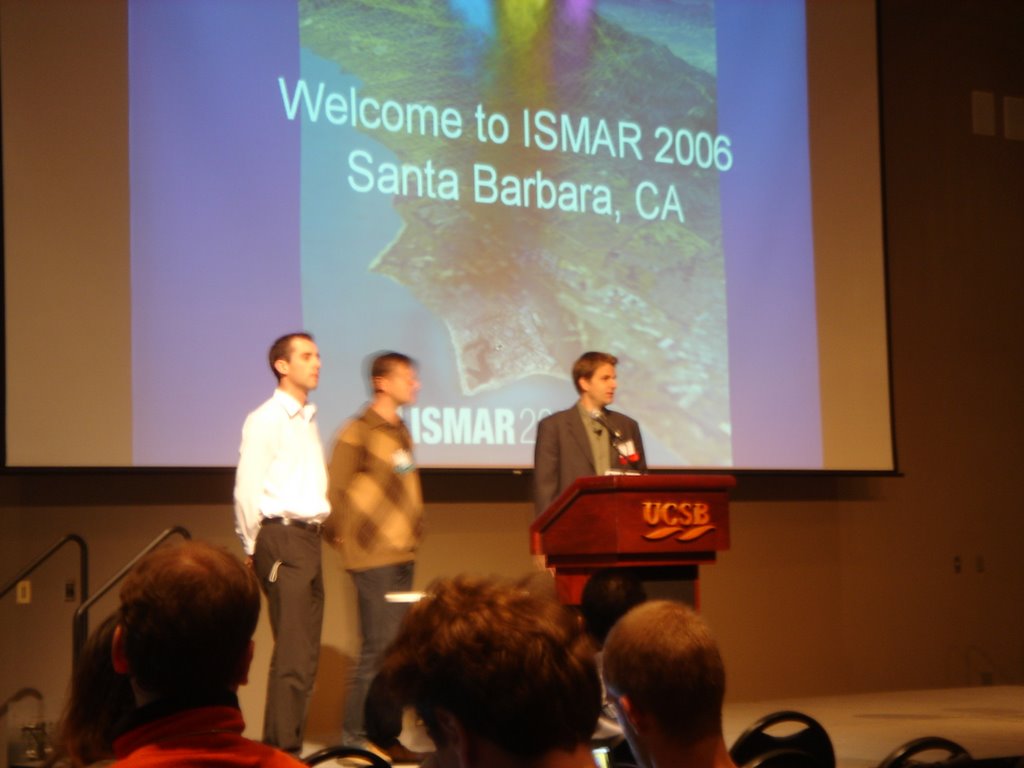
The IEEE ISMAR conference (International Symposium on Mixed and Augmented Reality) is the annual meeting of researchers who work in the domain of Augmented and Mixed Reality. Its current schedule is to be held every two years in the US, then in between once in Europe, then in Japan. In the last year, ISMAR 2005 was held in Vienna, and this year it was in Santa Barbara, California, hosted by University of California at Santa Barbara (UCSB), from 22. - 25. October 2006.

I have been active in the steering committee of this conference since its beginning in 1998 when it started as a simple workshop (IWAR 98). This conference provided the opportunity to meet again familiar faces and also get acquainted to new players in this field.

For the 2006 ISMAR meeting, 105 papers had been submitted (including posters: 117). During a weekend session of the program committee (which had been held in June 2006 in Los Angeles) where I attended as area chair, 30 papers were selected for acceptance, which translates to an acceptance rate of 29%. Printed Proceedings and a CD with the papers were given to attendees. The conference details, including the program, can be access at the conference web site at http://www.ismar06.org/.

The overall statistical data are as follows: there were 15 papers from Europe, 7 from America, 8 from Asia/Pacific. 15 posters, 2 keynotes, 2 demo sessions, 2 tutorials, and 2 workshops were included in the program. The whole conference was organized in a single track, so it was possible to attend each presentation. A total of 160 attendees were registered.

The meeting venue was the Corwin Pavillon at University of California at Santa Barbara (UCSB). The 2006 ISMAR general chair was Prof. Tobias Hoellerer (UCSB), whom I have known since his PhD work at Columbia University with Steven Feiner back in 1997.

Two workshops were held on the Sunday before conference: Industrial Augmented Reality, and the Workshop on Mixed Reality in Fim Making. In addtion, there were tutorials for Computer Vision for Augmented Reality, Head-Worn Displays: Fundamentals and Applications, and a Student Research Colloquium.

I attended the workshop on film making. 9 papers were presented, including a keynote by Paul Devebec (USC). Mixed Reality (MR) can be a useful tool in pre-visualisation, before expensive movie scenes are being filmed. In TV, MR is being used with Chroma-key techniques to merge real sceneries with graphical information, or with placing the actors into sceneries outside the studio environment.

On Monday, the conference started with a keynote talk “The Poor Man’s Palace: Special Effects in the Real World” by Ramesh Raskar from MERL (Mitsubishi Research Lab). The last time I had seen him was at the very first IWAR workshop in 1998, which was the predecessor of the ISMAR conference. Ramesh presented his vision of applying special effects in the real world, by projecting graphics into the real environment. He also demonstrated a product from Mitsubishi: the Mitsubishi Pocket Projector, a miniature projecting system. In addition he discussed the use of photo-sensing RFID tag which could emit their information triggered by coded light.

A 2nd keynote was given on Wednesday by Prof. Tom Furness (University of Washington, Seattle). I have known Tom since 1998 due to collaborations in a US project on augmented reality. Instead of the originally planned topic on AR technology, he decided to give his presentation a personal touch: “My attempts to save the world”. First he started with his work for the US Air force in developing helmet-mounted displays for fighter airplane cockpits (1967). This work led to making a headset for dentist’ patients, distracting them from the dentistry work done on them. In 1989 he moved to U. Washington to found the Human Interface Technology Laboratory (HitLab) – in mid 2007 a new HITLab will be started in New Zealand . He co-founded Virtual Vision (now eMagin, Inc.), a company working on such head-worn displays. After developing the "Virtual Retinal Display", a new problem has been addressed: to provide true stereo displays, not just based on dual-eye disparity, but also on single eye accommodation: the wave front of the light is manipulated, simulating depth. He further got involved in using Virtual Reality (VR) for learning, working on the Puget Sound Cruise, a system for interactive learning about nature. He also is involved in PARVAC, the Pacific Rim visualization center for visualizing natural threats and disasters. The technology of “low vision” is used in helping the blind to improve eye sight. In his talk, he made a passionate plea for peace and against war. He finally proposed the founding of a “Virtual World Society”, with $30 membership per year, to help developing educational games.

The individual sessions dealt with applications of AR, tracking, AR user interfaces, mobile tracking, mobile user interfaces, evaluations, calibration and resutrasion, multimodal AR, and visualisation. There were also sessions with 21 demonstrations and 15 posters.
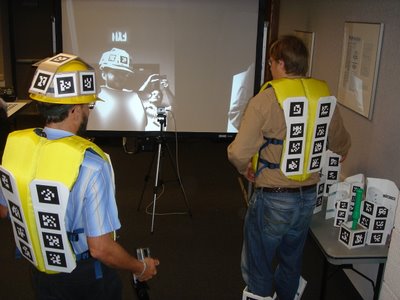
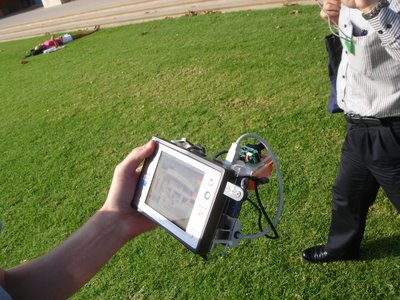


The progress on tracking, which is a very important subject for Augmented Reality, had been significant – basically visual tracking can be considered as being solved, except for specific cases and lighting conditions.

In general, in the US the interest in the technology of Mixed and Augmented Reality has slowly faded over the past years, whereas in Europe and Asia the technology still is quite actively pursued. This may lead to ISMAR being no longer held every 2 years in the US.

Saturday, October 28, 2006

Pictures from the ISMAR conference


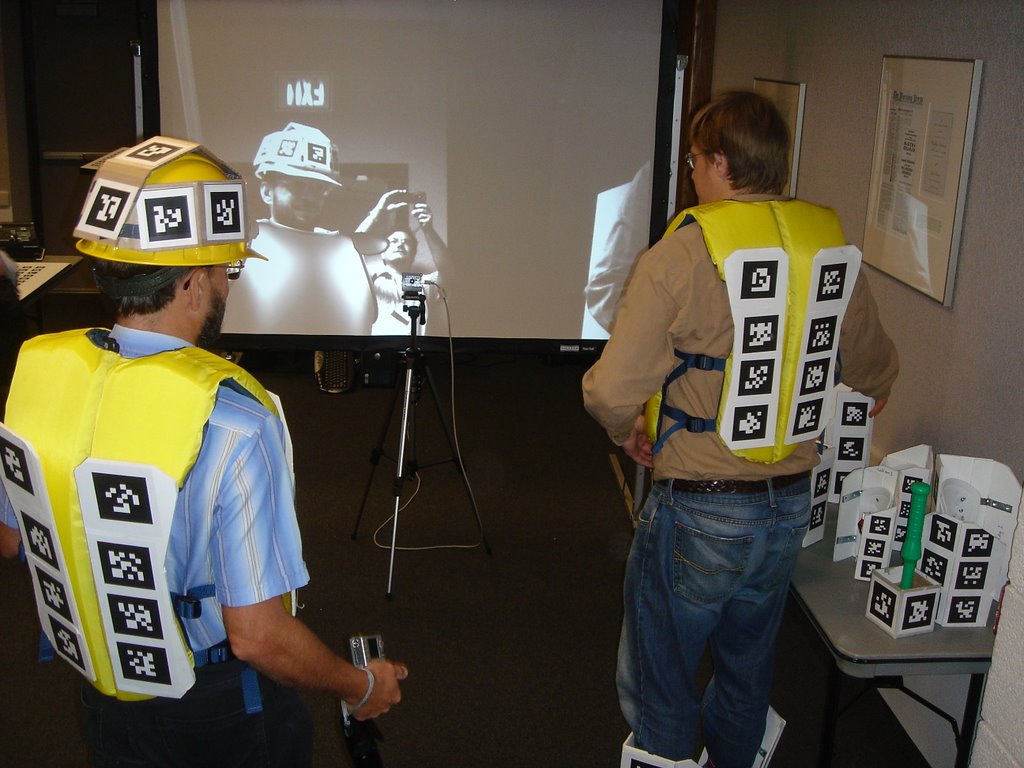
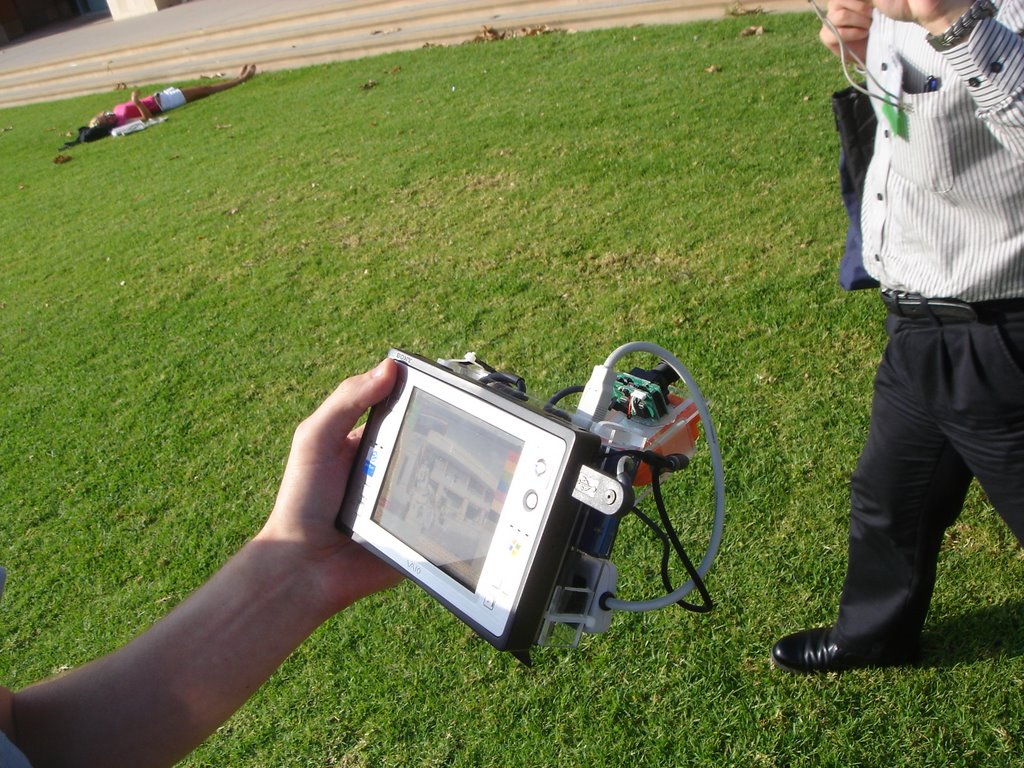
The annual ISMAR conference was held in Santa Barbara from Sunday, 22.October, until Wednesday, 25. October. On Sunday I attended the Workshop on Mixed Reality Technology for Film Making, where the applications of this technology to the movie industry were discussed. During the 3 following days, single-track presentations of research results were presented as papers and demonstration.

Friday, October 27, 2006

New Blogger

As of a fw days ago, I moved this blog to the "betablogger", a new way of using this blogger host. This allows a slightly different way for me of publishing my entries here - should make no difference to you viewers.

One notable difference: I no longer can use the tool "Hello" to upload pictures (Hello, Picasa, and Blogger used to work together quite well, but not this does not work anymore). As you may have noticed, the pictures in my posts now can appear in different sizes, and can be left- or right-justified. You still can click on them to get a high-resolution version (1024x768).

Sunday, October 22, 2006

New Photoalbum

I tried out a new photoalbum, on Google / Picasa. Looks like a nice and easy way of sharing lots of pictures. I put there more pictures from various events and travel. Will be expanded!

Friday, October 20, 2006

Travel to Santa Barbara

in a plane, to the US. First Class on Continental Airways is quite extrodinary, and always has been in my experience. Sometime back in 1999 I got an upgrade to US domestic first class, from LA to the East Coast. What a huge legroom! I believe it is longer than any other airline first class. But that comes at a cost of the Economy class: when a few months later I flew Continental Economy US domestic, I noticed how small the distance between the seats was - the knee bumed against the previous seat.

A great meal, and I watched movies on the video-on-demand system: "Click", with Adam Sandler, followed by "A Scanner Darkly". The latter movie was a dark depiction of drug addiction in the future. Unfortunately, I dozed off for about 1/2 hour while it was running on that little TV monitor in front of me, so it appeared even more surrealistic to me than intended, since I lost the string of action somewhat. But nevertheless, I would recommend it: it is in cartoon style, but filmed as a real movie, then with some "posterisation" effect (reduction of colors) made to look as if drawn as a cartoon. Quite disturbing from its content...

And then "The Maltese Falcon". I have watched this movie numerous times, on TCM (Turner Classic Movies), and even once in a movie theatre (in West Hollywood, Fairfax Avenue, summer 2000). But I keep forgetting what it is about and how it ends, so everytime I watch it, it seems new to me. It is so stylish, in its "film noir" theme and its seemingly pointless chase of that Falcon. Stereotypes of characters which shaped the career of actors (Humphrey Bogart, Peter Lorre, Sidney Greenstreet), paving the way for the ultimate film noir "Casablanca". I could not miss that treat to watch that film again, probably for the thousandth time. (And it did not matter that I again fell asleep for a few minutes, as the sleep deprevation slowly caught up with me).

In Los Angeles, I had rented a car from Fox Rent A Car - they had the cheapest car rentals, starting at $15 per day. I splurged a bit and spent $20 per day - for a PT Cruiser! In the shuttle from the airport to the rental location, every car renter said that they had never heard before from this Fox company, but that they were quite thrilled about the inexpensive price.

At 11:00pm I arrived in Santa Barbara.